Friday, March 29, 2013

Interviewing

An interview is a conversation between two or more people in which questions are asked. A journalistic interview is different than other  interviews because it is to gather information for the unseen audience.You are interviewing someone for information not for a job.

To prepare for any interview, you must always have your questions ready. This is critical for a successful interview. Some important things to remember while interviewing someone are to look for specific answers to your question and to ask a lot.


After the interview it is important to thank the person for the information they gave. You can use the information that you received in the interview by showing your questions, and their answer to your questions.

"Interview." Wikipedia. Wikimedia Foundation, 17 Mar. 2013. Web. 29 Mar. 2013.

"The Bulldog Bulletin Introduction to Journalism." The Bulldog Bulletin Introduction to Journalism. N.p., n.d. Web. 29 Mar. 2013.


Thursday, March 21, 2013

Inverted Pyramid Structure


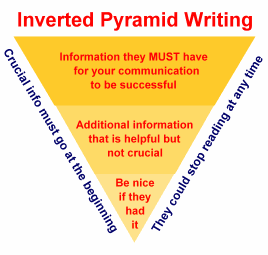
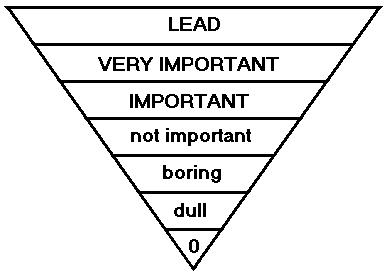
The inverted pyramid is a metaphor used by journalists explaining about the order you should write information. The important information should always be first.

This concept is used by many journalists, and it is  used in many news stories. The key elements of writing using the inverted pyramid structure are to always put the most important information first. The climax of the story should be in the beginning. You must tell the who, what, when, where, and why first. These things are important concepts to make sure the story is not boring and readers will get a better understanding of the main idea. Also if the reader does get bored after reading the first few sentences, then it is good that they already know the important information because it was already stated in the beginning  of the article.

One example is, a man was found dead at the park yesterday. He had bullets in his body, the killer was not found, but the police are currently searching. This works because I stated the important facts in the beginning. I used the Pyramid Structure by leading with the important information, and then the details.


This concept is important to the class because using the Inverted Pyramid Structure is extremely important. Without it, our writing in class would be boring and it would be written incorrectly. I will apply this concept to  my future work by using the inverted pyramid structure by always leading with the important information first.


Citations:
"Inverted Pyramid." Wikipedia. Wikimedia Foundation, 03 July 2013. Web. 20 Mar. 2013.

"The Bulldog Bulletin Introduction to Journalism." The Bulldog Bulletin Introduction to Journalism. N.p., n.d. Web. 20 Mar. 2013.

Stovall, James Glen. Journalism: Who, What, When, Where, Why, and How. Boston: Pearson/Allyn & Bacon, 2005. Print.


Tuesday, March 12, 2013

Bias in Journalism

Bias means opinion. If something is biased, then it does not have a neutral point of view, it is basically one sided.


To be a journalist, understanding bias is very important. A good journalist would show both sides of the story, and make sure no information is hidden. Also, there cannot be any assumptions. When writing, a journalist should make sure to use only facts, not biased opinions. If they do, then they should make sure to show both sides of the story. This is key to understanding bias.
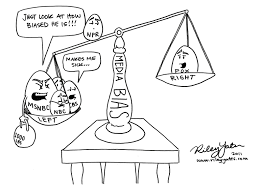
An example of a journalist using bias is when he or she says the Warriors are going to the NBA Finals. This is not a fact but a biased opinion. To change this phrase, the journalist would say the Warriors have a good chance at making the playoffs, and maybe even the NBA Finals, because of their great record. On the other hand, the team from the East, the Miami Heat, will be a tough team to beat, with the big three of LeBron James, Dwayne Wade, and Chris Bosh.

The concept of bias is a key factor to Journalism, and it shouldn't be used incorrectly. Bias is important in this class because when we are writing, we shouldn't use bias. I will apply the concept of bias to this class by always stating both sides of the story, only using facts, and not making assumptions.


"Media Bias." Wikipedia. Wikimedia Foundation, 03 Nov. 2013. Web. 12 Mar. 2013.

"The Bulldog Bulletin Introduction to Journalism." The Bulldog Bulletin Introduction to Journalism. N.p., n.d. Web. 12 Mar. 2013.

Stovall, James Glen. Journalism: Who, What, When, Where, Why, and How. Boston: Pearson/Allyn & Bacon, 2005. Print.

Friday, March 8, 2013

Journalistic Integrity

Journalistic Integrity means not plagiarizing, checking to make sure your sources and facts are accurate, and assuring there is a good solid basis for the story. 

Some important elements of Journalistic Integrity are to be completely accurate and to avoid bias. It is not about the writers opinion, it is about the facts. Some journalistic codes also include a concern with racism, religion, and physical or mental disabilities. Also you cannot tell lies or you will confuse the reader.

An example of a journalist not using journalistic integrity is when he or she is not accurate. Say they write about sports. They say that a particular sports team will destroy the other team just because they like that team. This would be their opinion, not accurate facts. 

Having journalistic integrity is very important, and without it, journalism would not very reliable. The concept of journalistic integrity is important because if the readers do not trust your information, then you are not a worthy journalist. I will apply the concept of journalistic integrity in this class by being as accurate as possible, not using my opinion, but true facts, and by not plagiarizing others work. 

"Journalism Ethics and Standards." Wikipedia. Wikimedia Foundation, 03 May 2013. Web. 07 Mar. 2013.
"Taylor Middle School." Taylor Middle School. N.p., n.d. Web. 07 Mar. 2013.
Stovall, James Glen. Journalism: Who, What, When, Where, Why, and How. Boston: Pearson/Allyn & Bacon, 2005. Print.